Monday, February 13, 2012

The Nudist Annex

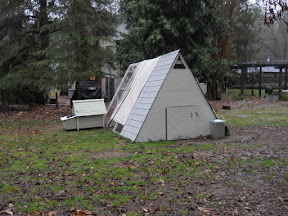
So, as you know, we have resurrected the original chicken coop. When our family first got chickens we bought a large doghouse with insulated walls and converted it into a "chicken coop" by adding a roost and two nest boxes on the back. After two of our four little Barred Rock chicks were brutally murdered by a neighbor's house cat we decided to up the security and build the existing "Deluxe Chicken Ark". The little doghouse/coop was retired.

But since the arrival of our new Naked Neck Turkens we have found a new need for it. As a nudist annex. The Turkens were getting beat-up and there wasn't any sign of that stopping so we decided to create a safe haven for them.

There was no way we were about to build a whole new coop and run for just two chickens, no matter how stinkin' cute. So we dug out the old doghouse/coop...


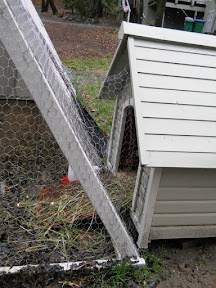
...cut a hole in the existing run, used some scrap chicken wire and secured a tunnel from the run to the front of the little coop...


...sectioned off a small piece of the run with some fencing and tent stakes...


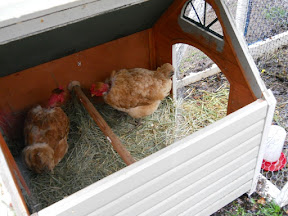
...and inserted the Turkens, Molter and Scully. Their little coop is the perfect size for the two of them and has a cute drawbridge door that acts as a ramp into their part of the outdoor run.


I checked on them a few times today, since it has been raining, and everything is dry and warm. Success!


Real Life

Wouldn't it be nice if a post titled "Real Life" was... well... nice? Sorry, not this time. Being a new livestock owner, I would like to think that those of the same species can get along. Rabbits should be able to get-along with other rabbits and chickens should be civil with other chickens. Ha! Boy have I learned a lot here.

Rabbits tend to be territorial which is why each rabbit needs its' own cage. Easy. Chickens are "flock" animals which means they usually like to live with other chickens. However-- as I have learned the hard way-- chickens don't always accept other chickens. If they grow-up together there is usually no problem. Easy. If you introduce new chickens to an established flock, there is usually a problem. Hard.

I found myself at the hard part.

So this afternoon, Trevor and I added an extension to our existing chicken coop. Lucky for us we still had our original "chicken coop" that we converted from a wooden insulated dog house. 
We had already added a large nesting box, roost, and drawbridge door so all we really had to add was chickens. Rejected chickens. This tiny doghouse/coop is just the right size for two chickens. Just what we (and the beat up Turkens) needed! Next I will post what we did to keep the two groups separate without building another chicken run or using more space than the existing coop took up.

By the way, we decided to name the Turkens: "Scully" and "Molter". Our little joke for X-files fans the world over.

Thursday, February 9, 2012

Integration of Newbies

I've come to the realization that chickens are not the cleanest of animals. I would also never eat or boil chicken legs to get broth. You could probably guess as to why. Really, any other part of the chicken is fair game, but just the sight of the feet and I'm out. I never really felt like this before raising chickens myself. I didn't have an opinion on the edibility of chicken legs. Now I do. No.

Anyways-- believe it or not, this post is actually supposed to be about our two new chickens.

I do have a little experience with introducing and integrating new chickens into an existing flock. I can tell you now that there is no magic formula to making it work. You just have to try a few things and if it works, yay. If it doesn't, it doesn't.

I was lucky the first go-round introducing the Wyandotte and Gold-Sexlink chicks to the older Barred Rocks almost a year ago. I just let the new chicks in the Barred Rocks' run supervised a few times and then one day just left them in. Success! Its not going to be that easy to get my old flock of six to accept the new two. First off, the numbers are against the Turkens. Second, the flock of six have been together for nearly a year and it's easier for them to pick on two newbies. And third, the two Turkens have no feathers on their heads or necks which makes it more obvious they are not part of the group and makes them easier to peck at.

My idea? I put the two Turkens in my spare rabbit cage (30"x36") with a small feeder, water, and some hay then placed the cage in the coop run under the canvas shade cloth. This way the Turkens don't sit in the sun all day, they have plenty of food and water, and the other hens can see them and hear them without being able to peck at them. Last night I put them in the coop house at dusk and this morning I put them back in the cage at dawn. My only real concern is whether they will comfortably lay eggs in the open and bright cage. I may let them into the coop house for a few hours to lay this morning.

Nothing is guaranteed with new chickens. Hopefully in a few days they will be ready to integrate with the rest of the flock.

p.s. The Turkens still don't have names.

Tuesday, February 7, 2012

Just the Right Size


She just turned two and is already a pro at collecting eggs and putting them carefully in the carton. Not only that, but now I don't have to crawl in myself. **insert maniacal laugh here**

One Of These Things Is Not Like The Others...


You guessed it! We got two new chickens. Naked Neck Turkens!!! You don't even know how excited I am about having two in my flock... I've only posted about them twice in the last six months. I actually held back from posting about them more frequently, but I thought you might get annoyed.

One of Trevor's customers graciously sold two of them to us and in the few hours we've had them, they have already laid an egg. The two Naked Neck Turkens are crazy cute (even though everyone's first response is 'those things are ugly') and I love them so.

But they need names.... any thoughts?

Saturday, February 4, 2012

Scary Color Genetics :: Thistle

I feel like I've learned so much about rabbits in such a short time. Today I have been trying (very very hard) to teach myself about the complexity of rabbit color genetics. It is so much easier for me when I have something to look at and compare to examples I am being given. I am a tactile learner, so reading text doesn't put a clear picture in my head. I need to see, note, and classify.

What I have done today, thanks to Three Little Ladies Rabbitry's site, is put together the color genetics of my three rabbits. Once I took notes from TLL Rabbitry's site I looked at Thistle's pedigree. Thistle was probably the hardest to come up with because he is a Ruby-Eyed White (REW). I have learned that a REW is just masking other color traits.

Imagine dipping a colored rabbit into white paint. Obviously you don't really want to do this... But theoretically, it would be difficult to tell what color is underneath or what color babies that rabbit is able to have until you breed them. That is where I'm at.

Thistle's genetic color sequence is: aa B_ cc D_ EE

"aa": the most recessive Agouti gene. This means he got an "a" from each parent making him fully "self". His hair is one color throughout his body and the individual hairs are also one color. If he had just one of the more dominate genes, either "A" or "at", he would be chinchilla colored or colored with a white underside respectively. Since he has two of the recessive "a" genes he is all one color.

"Bb": the Black/brown gene. Thistle has one known gene, dominant Black. His second gene in this set (one comes from each parent) could be either a "B" for black or a "b" for brown/chocolate. We won't know until he throws out some black and or chocolate kits because of that masking REW gene below.

"cc": the Color Saturation gene. He has two of the most recessive genes here as well which makes him a REW. "c" is the also known as the albino version of the gene. If he had just one of the more dominant genes ("C", "cchd", "cchl", or "ch") he would be full color, chinchilla dark, chinchilla light, or pointed-white respectively. Instead he has two of the albino "c" genes which is the only way you get a REW.

"D_": the Dilution of Color gene. "D" is full strength and "d" is diluted. Here is where it gets a little messy. When I do Punnett squares to figure out this gene Thistle has a 50% chance of being "DD" and a 50% of being "Dd". Since I don't know what the second gene is I put in a place marker until I figure it out with future litters

"EE": the Extension of Color gene. With "E" the color extends fully along each hair, "ES" extends dark color, "e" extends light color, and "ej" makes the harlequin coloring. Thistle's father and mother are both "EE" which makes it easy to tell that he is as well.

Look at that! We just painfully joyfully went through color genetics for a rabbit using a 3-generation pedigree. Aren't we fancy!

Friday, February 3, 2012

Our Half of the Garden and more...

As I've said before, we are sharing a large fenced in garden with our neighbors this year and we have been working on the soil. Our house and garden are situated on top of an old riverbed so most of our soil is decomposed granite and sand. Not really ideal. In addition to sad starter soil, the horse manure that was added to the garden bed when it was built two years ago is long depleted. So needless to say, the dirt needs a little TLC. We have started adding organic material and compost and next week we will be adding rabbit manure, more compost, vermiculite (to help with water retention), and we will top it all off with black garden cloth to heat up the soil and ready it for planting next month.

You can see our half of the garden the best in this photo. Yes... That is a super high fence. But if you knew the deer around here, you would know that this 8-foot fence barely keeps them out. They practically have springs for legs. Our part of the garden is 13 x 22 feet. Using the "square foot method" we should be able to get quite a bit of food out of this space. I'm hoping for enough for a veggie every night for dinner and some leftovers for canning. Cross your fingers! I'm ordering seeds on Thursday.

As a mother, I am obligated to include a picture of our daughter giving "her" chickens hugs. Enjoy your weekend!